


Table of Contents
- The Rise of Answer Engines
- Local Search is Especially High-Intent
- How Do People Search?
- Keyword Research for Electricians: What Actually Drives Results
- On-Page SEO: Turning Your Website into a Lead-Generating Powerhouse
- Local SEO for Electricians (Where the Real Money Is)
- Collect and Respond to Customer Reviews
- Build a User-Centric Website
- Build Local Citations and Directory Listings
- Technical SEO: The Silent Ranking Factor for Electricians
- How to Outsmart Your Competition: An SEO Analysis for Electricians
The Rise of Answer Engines
The shift to AI-powered platforms has taken traditional SEO into exciting new territory: Answer Engine Optimization (AEO) and Generative Engine Optimization (GEO).
What does that mean?
It’s no longer just about appearing on a list of blue links only.
Now, it’s also about your business being directly cited by AI as the answer to a user’s question, on top of those classic blue links. And let’s be honest, that’s pretty mind-blowing.
Don’t just take our word for it—check out what Andrew Warden, CMO at SEMrush, has to say as he breaks it all down in this insightful interview on Uncensored CMO:
In other words, the new AI-driven SEO is like your old SEO on steroids—or, if you want to sound fancy, let’s call it AI SEO. Either way, it’s still a total powerhouse in 2026.
And here is the funny thing: To do AI SEO well, you need a solid traditional SEO foundation.
And here it is – SEO remains one of the best ways to connect with homeowners and businesses that need electrical services or are seeking the best electrician in their area.
So, should you invest in SEO?
The answer is “yes”, and it will remain your not-so-secret weapon to outshine local competitors and build sustainable brand growth.
And with the rise of AI citations, being the “trusted source” isn’t just a nice-to-have—it’s a must.
So, you get that right.
SEO hasn’t just survived—it’s leveled up by including optimization for Large Language Models (LLMs) like ChatGPT, Perplexity, and Google’s AI Overviews.
Translation for normal people: There are more ways than ever for your business to get discovered than just a blue link or Google Maps.
But here’s the kicker—you’ve got to master your SEO game and absolutely nail those best practices.
No shortcuts, no half-measures.
When homeowners, property managers, or businesses need an electrician, they’re not casually browsing for fun.
They have an issue.
They need something.
And if they have an issue and need something, they pick up their phones most of the time and start searching for something very specific, like:
- An electrical panel replacement
- An EV charger installation
- New LED recessed lighting
- Fancy smart switches (because who doesn’t love those?)
- An emergency generator installation
- You name it
And if your company isn’t showing up on Google, Maps, or AI search results, well… you’re basically invisible to the people who are ready to hire right now.
But hey, you probably already knew that, right?
Let’s agree on one thing: SEO for electricians isn’t about chasing clicks or padding traffic stats just for fun.
It’s about owning your local market, earning trust faster than a flipped breaker, and turning searches into ringing phones.
So, SEO isn’t just a “nice-to-have”—it’s the digital equivalent of being on-call.
When someone’s lights are flickering or their panel’s making that ominous buzzing sound, they’re grabbing their phone and searching right now.
And guess what?
Google is basically the dispatcher deciding who gets the job.
Local Search is Especially High-Intent
People searching for nearby services on their smartphones aren’t just browsing—they’re ready to act.
Now, here’s the thing – Some people hate ads or have a negative opinion about them.
In other words, they do not click on the Google Local Services Ads blocks or sponsored links – same for Bing.
These people do not mind scrolling through to avoid that advertising mess, or, lately, asking the AI.
Here’s another fun fact: Google reports that 76% of local smartphone searches lead to a visit within 24 hours, and 28% result in a purchase.
That’s why showing up in local results and on Maps is a big deal.
Optimizing your Google Business Profile (GBP) isn’t optional—it’s foundational.
Google even says so, framing Business Profiles as a key way to boost local rankings when customers search near your location.
You may think to yourself, “All right, genius, I know that about Google Business Profile and Google Maps, but what about websites?”
Great question.
Modern SEO for electricians isn’t about stuffing keywords on a page anymore and hoping for the best.
Your website needs to load fast, feel compelling, and work seamlessly on mobile.
Why?
Because Google’s ranking systems prioritize user page experience, including core web vitals such as speed, stability, and mobile usability.
If your site doesn’t check those boxes, you’re risking a one-way ticket to page two, and let’s face it, no one goes there.
And let’s not forget trust—it’s the real currency in home services.
Reviews aren’t just a nice touch; they’re make-or-break.
So if you are ten or fifteen years in business with 7 reviews, you need to take a moment to rethink your life.
Studies show that many customers won’t even consider a business with a rating below a certain threshold.
Capital One shared some interesting insights in a 2026 study that we recommend reading. They say that “Conversion rates peak with a 4.9 out of 5 rating.”
Here is the article: https://capitaloneshopping.com/research/online-reviews-statistics/
But if you do not want to read the entire article, read this extract:
- Local businesses average 39 reviews and 4.4 stars (out of 5).
- 85% of consumers consider a business’s star rating to be the most important aspect of their online reviews.
- Only 20% of consumers would consider choosing a business with an average rating of 3 stars or lower.
- 55% of consumers only consider businesses with an average rating of 4 stars or higher.
And if you wonder where people are going to read these reviews, check this graph from BrightLocal:
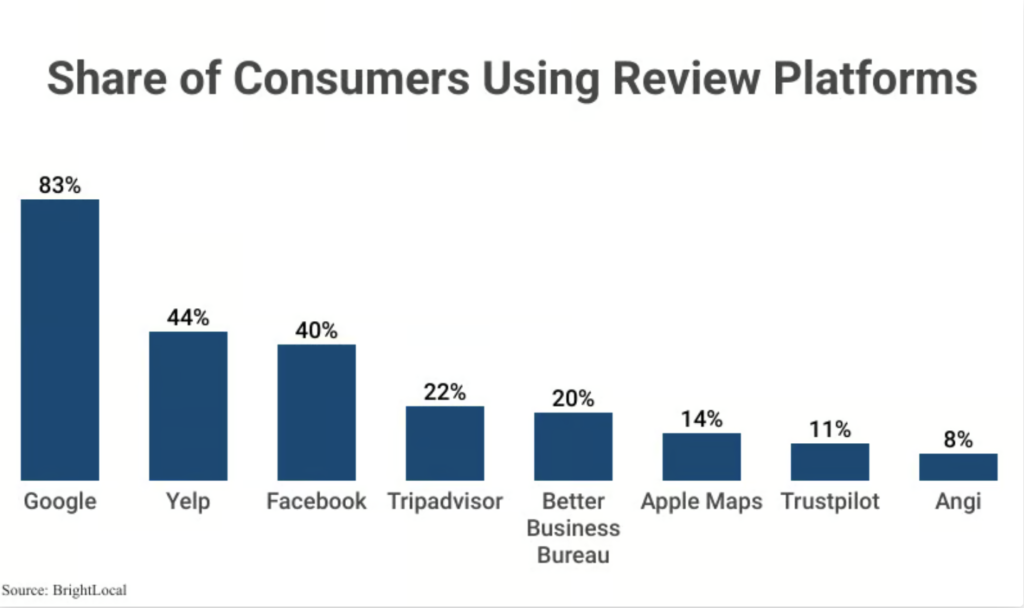
So, should reputation management and review generation be part of your SEO strategy?
Yeah, those are core SEO tasks, not afterthoughts.
This is why we will cover here the full circuit:
- Local SEO (including Maps, Google Business Profile, citations, reviews, and service-area strategies).
- Technical SEO (like Core Web Vitals, crawlability, and site architecture).
- Content SEO (service pages, intent-driven FAQs, and case studies that actually convert), and even AI search readiness.
- We’ll also dive into structured data—because Google uses it to better understand your pages and serve up richer results that can boost engagement.
But before we dive into these points, let’s dig deeper into how people think and what they mean when they are looking for something specific, like an electrician.
How Do People Search? Go Figure!
Have you ever wondered how people found you? You may even have asked them the question directly occasionally.
It’s time to put yourself in people’s shoes.
When people need an electrician, their searches typically fall into three main categories:
- Emergency Mode: This is the “Help, I need someone NOW!” type of search. Think: “24-hour electrician near me.” These are high-stress, high-urgency situations where someone’s power is out, a breaker’s tripped, or there’s a mysterious buzzing sound that’s making them nervous. They’re not browsing—they’re looking for immediate help.
- Service-specific: These searches are more targeted and focused on a specific need, such as “EV charger installation electrician” or “recessed lighting expert.” Here, people know exactly what they want, and they’re looking for a professional who can deliver that specific service.
- Research Phase: This is the “Let me figure this out first” crowd. Searches like “How much does an electrician cost?” or “What’s the best type of wiring for my home?” fall into this category. These folks are gathering information before making a decision, and they’re likely comparing options to find the best fit.
Here’s the thing-
Roughly 70% of these local-specific searches happen on mobile devices.
Do not take our word for it, check these guys: https://aioseo.com/seo-statistics/#:~:text=is%202%2C312%20words.-,Mobile%20Search%20Statistics,as%20their%20main%20internet%20connection.
And more often than not, they come with a sense of urgency or a need for local expertise.
That’s why your SEO strategy needs to go beyond just sprinkling in a few keywords.
It’s about showing up where and when it matters most. Therefore,
- Your website needs to load quickly, because no one’s waiting for a slow site when their power’s out.
- Highlight your proximity because people want someone local, not someone who has to drive 90 minutes to reach them.
- Build trust because no one’s hiring an electrician they don’t feel confident in. That’s good reviews with professional and careful responses, folks!.
In today’s world, being visible in search results isn’t just about ranking—it’s about being the solution people need, exactly when they need it.
Magic happens when someone needs you and trusts you.
Keyword Research for Electricians: What Actually Drives Results
Let’s talk about the backbone of electrician SEO, shall we?
That’s targeting high-intent, service-based keywords.
These are the search terms that don’t just bring traffic—they bring the right traffic.
You know, the kind of people who are ready to pick up the phone and book your services.
Those are the ones you like, don’t you? So, here you go:
Core Electrician Keywords
These are the bread-and-butter terms that every electrician should be targeting:
- Electrician near me (because proximity is everything)
- Licensed electrician (because trust matters)
- Residential electrician (for homeowners in need)
- Commercial electrician (for businesses with big projects)
High-Value Service Keywords
Now, let’s get into the money-makers—the specific services people are actively searching for:
- Electrical panel upgrade (a common and high-ticket service)
- EV charger installation (because the future is electric)
- Generator installation (for those who like to stay powered up)
- Electrical inspection (a must for safety-conscious clients)
- Outlet repair (small but essential)
- Lighting installation (because ambiance is everything)
Check this – We used SEMRush for the following high-level keyword search:
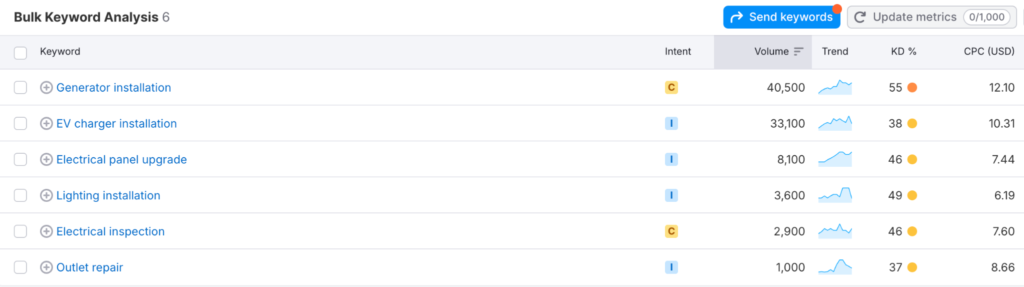
Here’s the deal.
Each of these major services deserves its own dedicated, optimized page on your website.
Why?
Because bundling all your services on a single generic page is like trying to win a race with a flat tire—it weakens your rankings and confuses search engines. Got it?
Then,
Use Local Modifiers: The Secret Sauce
Adding local modifiers to your keywords is a game-changer.
For example:
- “EV charger installation electrician in West Chester, PA”
will always outperform a generic term like “EV charger installation.”
Why?
Because it’s specific, relevant, and exactly what someone in that area is searching for.
Don’t Forget About Voice Search
With the rise of smart speakers and voice assistants, more people are asking conversational questions like:
- “Who’s the best electrician near me?”
- “How much does an electrical panel upgrade cost?”
- “Can I get an EV charger installed in my garage?”
Your content should be ready to answer these questions clearly, directly, and in a conversational tone.
Think of it as a friendly chat with a potential customer—except it happens on Google.
The bottom line here is that keyword research isn’t just about stuffing your site with random terms.
It’s about understanding what your customers are searching for, meeting them where they are, and making it as easy as possible for them to find you.
When done right, it’s not just SEO—it’s a direct line to more calls, more bookings, and more business.
On-Page SEO: Turning Your Website into a Lead-Generating Powerhouse
Think of on-page SEO as the wiring behind your website—it’s what powers everything and keeps it running smoothly.
Done right, it helps Google understand your pages and, more importantly, helps potential customers trust you enough to pick up the phone.
Let’s break it down into simple, actionable steps – with a little electrician flair, of course.
Key Best Practices for On-Page SEO
Here is what you need to do well, among all the other things we discussed so far:
One Clear H1 Per Page (Only One Per Page)
Your H1 (Headline 1) is like the main breaker in an electrical panel—it sets the tone for the entire page.
For example, if your page is about:
“Electrical Panel Upgrades,”
Make sure that’s your H1.
Don’t confuse Google (or your readers) by throwing in multiple H1s or vague titles to sound witty or cool.
Keep it clear and focused.
Keyword-Optimized Title Tags and Meta Descriptions
Think of these as the labels on your circuit breakers—they tell Google and users exactly what each page is about.
Here is what it looks like on Google Search:
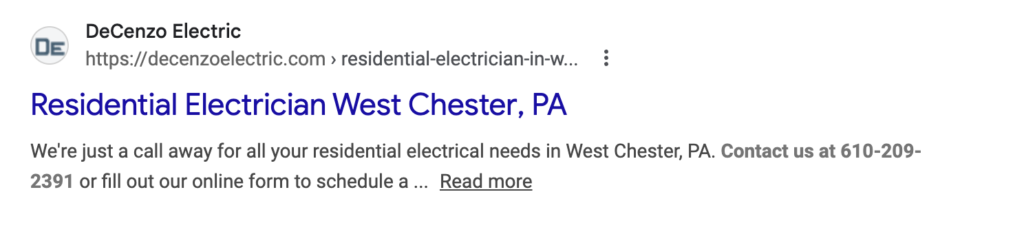
For instance:
- Title Tag: “24/7 Electrician [Your City]”
- Meta Description: “Need a 24/7 Electrician? Our licensed electricians in [Your City] provide fast, reliable service. Call now!”
These little snippets are often the first impression you make in search results, so make them count.
Bonus tip: Use the same keyword in your title, meta description, and H1.
Descriptive H2s and H3s
Subheadings (H2s and H3s) are like the wiring pathways—they guide users (and Google) through your content.
Instead of generic subheadings like “Our Services,” go for something more specific. For instance, if you have a page on “electrical panels upgrade,” try to include something like:
- H2: “Why Upgrade Your Electrical Panel?”
- H3: “Signs Your Panel Needs an Upgrade”
This not only improves readability but also helps you rank for related keywords.
Natural Keyword Usage (No Stuffing!)
What’s a natural keyword use?
Rest assured, nothing that is raised in pastures.
We refer here to keyword overload, plain and simple.
Keywords are important, but overloading your page with “electrician near me” twenty times is like overloading a circuit—it’s not going to end well.
Got it?
Instead, weave keywords naturally into your content.
Here is an example to clarify what we mean:
“Our licensed electricians in [Your City] specialize in EV charger installations, ensuring your home is ready for your new car.”
See?
Informative, natural, and keyword-rich without being awkward.
Optimized Images with Alt Text
Images are great for breaking up text, but they need to pull their weight for SEO, too.
Therefore, use descriptive alt text that includes keywords.
Here is another example of what you should do:
- Instead of using a file name like: “IMG1234.jpg”
- Use: “Licensed electrician installing an EV charger in [Your City].”
This not only helps with SEO but also makes your site more accessible.
Also, just a little side note that is important: Convert your files to WebP files instead of JPG or PNG.
WebP files will load faster.
Clear Calls-to-Action (CTAs)
Don’t leave your visitors guessing about what to do next.
CTAs are like the light switches of your website—they guide users to take action.
Examples:
- “Call Now for 24/7 Emergency Service”
- “Request a Free Quote Today”
- “Schedule Your Electrical Inspection Online”
Make them bold, visible, and easy to click.
Even consider static navigation with your main CTA. So that when people scroll your page, your CTA follows their scroll, and they can click it at any moment.
Internal Linking for Authority and Crawlability
Think of internal links as the grounding wires of your website—they connect everything and keep it stable.
For example, if you have a page on “Electrical Panel Upgrades,” link it to related services such as “Home Rewiring” or “Generator Installation.”
This not only helps users navigate your site but also signals to Google that your site is a trusted authority on all things electrical.
The bare minimum is one internal link per page. But you need more, of course, to improve your user experience.
Remember Those Things About On-Page SEO
On-page SEO isn’t just about pleasing Google—it’s about creating a seamless, user-friendly experience that turns visitors into leads.
By following these best practices, you’re not just optimizing your website; you’re building a digital storefront that works as hard as you do.
So, flip the switch on your on-page SEO. Here is a video by Osborne Digital Marketing that is worth a five-minute watch:
Local SEO for Electricians (Where the Real Money Is)
Let’s be honest, local SEO is the number one growth lever for any electrician.
Before diving into those tactics, remember what search engines are trying to accomplish.
As we’ve seen previously, Google’s primary goal is to provide the most relevant, helpful results for each search query.
When someone searches for “electrician in [your city],” Google analyzes hundreds of factors to determine which businesses to show.
As a reminder, these factors fall into three main categories:
Relevance:
Does your website clearly explain what services you offer and where you operate?
Google looks at your content, page titles, and business information to determine if you’re a good match for the search.
Authority:
Does Google trust that you’re a legitimate, established business?
This is influenced by customer reviews, how long your website has been around, and whether other reputable websites link to yours.
Proximity:
How close is your business to the person searching?
For local searches, Google prioritizes businesses near the searcher’s location.
Your local SEO strategy needs to address all three areas.
You can’t just focus on one and ignore the others.
Now, the million-dollar question for you: In your SEO toolbox, what can help you achieve this?
Optimize Your Google Business Profile
Your Google Business Profile (formerly Google My Business), of course.
It is the foundation of local SEO.
It’s the information box that appears when someone searches for your business or relevant services in your area.
Start by claiming and verifying your profile if you haven’t already. Then, complete every section thoroughly:
Business Information
Use your exact business name as it appears on your website and signage.
Include your full address, phone number, and service area.
Add your website URL and business hours, including any special holiday hours.
But be careful.
Avoid spamming the name field of your profile to avoid suspension.
A typical bad example that some agencies use to boost their clients’ searchability on Google Maps would be:
- “XYZ Electrics LLC – Emergency Electrician”
- “XYZ Electric LLC | Electrician Near You”
That kind of practice is dangerous.
For Google Business Profile, this is considered spammy and an attempt to manipulate their platform.
You can get your profile suspended for this if they find you.
So, avoid at all costs.
Categories
Choose “Electrician” as your primary category. Straightforward.
Now, a bonus for you – You can add secondary categories like “Electrical Installation Service” or “Lighting Contractor” to capture more specific searches.
That’s all for that part.
Description
You do not have a major in literature for that part, but don’t be lazy either.
Write a clear, engaging description of your services.
Mention the types of work you do (residential, commercial, industrial) and your service area.
Include key phrases like “licensed electrician” and your city name naturally. You know the drill.
Photos
Upload quality photos of your work, your team, and your service vehicles.
Businesses with photos receive 42% more requests for directions and 35% more click-throughs to their websites.
Before uploading pictures, do some formatting:
- Instead of using a file name like: “IMG1234.jpg”
- Use: “Licensed electrician_[Your City]_[Your Main Keyword].jpg” and add a geotag – you are welcome!
Many articles talk about “high-quality pictures”.
The good news is that you do not have to be Ansel Adams.
If you have an iPhone, clean the lens, frame what you’re trying to take, and pay a little attention to the light.
Posts:
Share updates about your services, special offers, or helpful electrical tips.
Use the keywords in that content that you want to rank for.
Regular posts signal to Google that your business is active and engaged.
Also, keep your profile up to date with the latest changes. If you do not work on July 4th, then make it clear.
If you change your hours, add new services, or get a new phone number, update your profile immediately.
Inconsistent information confuses both Google and potential customers. You’ve been warned.
Collect and Respond to Customer Reviews
Reviews are critical for local SEO. There is no other way to put it.
They influence both your search rankings and whether potential customers choose to contact you.
So, some care is needed.
Businesses with higher ratings and more reviews consistently rank better in local search results.
Consequently, make review collection part of your standard process.
If you go on a job and you are done with the repairs or installation, ask for a review right there and then.
If you have missed that step, then send a follow-up message immediately thanking the customer and asking them to share their experience on Google.
Make it easy by including a direct link to your review page to reduce friction.
And do not forget to respond to every review, positive or negative.
Thank customers for positive or negative feedback and address any concerns raised in negative reviews professionally. Do not post a standard AI-generated flat response.
Your responses show potential customers how you handle service issues and demonstrate your commitment to customer feedback.
A local electrical contractor we worked with increased their review count from 15 to over 150 in six months by simply asking satisfied customers.
Their Google ranking jumped from page two to the top three local results, generating 40% more service calls.
Build a User-Centric Website
Your website is your digital storefront and a reflection of your work as an electrician.
That’s how people will perceive it!
So, it needs to be fast, mobile-friendly, easy to navigate, and reduce friction as much as possible.
More than 70% of local searches happen on mobile devices, so if your website doesn’t work well on phones, you’re losing potential customers.
Clear Navigation:
Visitors should find what they need within two clicks.
Create separate pages for different services (residential electrical, commercial, emergency services) and make your contact information prominent on every page.
Use static navigation and add your main CTA there.
Service Pages:
Create detailed pages for each service you offer.
Explain what’s included, typical pricing ranges, and why customers should choose you.
Use clear headings and bullet points to make information easy to scan.
Location Pages:
If you serve multiple cities or regions, create a page for each location.
Include the city name in the page title and content, and mention specific neighborhoods or landmarks you serve.
Contact Information:
Display your phone number prominently at the top of every page.
Include a contact form for people who prefer to send a message.
Consider adding a click-to-call button for mobile users.
Loading Speed:
Slow websites frustrate visitors and hurt your rankings.
Compress images (prefer WebP files), minimize code, and use reliable hosting.
Your website should load in under 2.5 seconds, and that’s a constant battle.
So, try this tool to measure your website performance from Google PageSpeed Insights:
Build Local Citations and Directory Listings
Citations are mentions of your business name, address, and phone number on other websites.
They work as boosters for your brand.
For your industry, there are over 60 sites where you can maintain citations.
These help search engines verify your business exists and operates in a specific location.
Start with major directories:
- Yelp
- Angie’s List
- HomeAdvisor
- Thumbtack
- Better Business Bureau
- Yellow Pages
Then add industry-specific directories, such as the National Electrical Contractors Association (NECA) or local chamber of commerce websites.
As the devil is always in the details, make sure your NAP information matches exactly across all listings.
Even small differences—like “Street” vs. “St.” or including a suite number on some listings but not others—can hurt your local SEO efforts.
Local SEO for Electricians (Where the Real Money Is)
As an electrician, you know that the most crucial work often happens behind the walls.
The wiring, the breakers, the panel—it’s all invisible to the homeowner, but if it fails, the lights go out.
Technical SEO is the digital equivalent of that essential, unseen infrastructure. It’s the foundation that supports every other marketing effort you undertake.
You might have fantastic service pages, glowing customer reviews, and a list of perfectly targeted keywords.
And that’s super good!
But if your website is slow, confusing for search engines to navigate, or technically broken, Google might never give it the ranking it deserves.
For an electrician’s website, where potential customers are often searching on their phones with an urgent problem, technical performance is not just a “nice-to-have.”
It can be the single factor that determines whether a frantic visitor calls you or clicks away to a competitor whose site simply works better.
Let’s pull back the drywall and look at the “wiring” of your website.
We’ll explore the key components of technical SEO, explaining not just what they are, but why they are so critical for connecting your business with customers in need.
Load Fast, Especially on Mobile
Let’s go back to our imagination exercise from before.
Imagine a customer’s lights have just gone out.
They pull out their phone, search for “electrician near me,” and tap on your website.
Then they wait.
And wait.
A slow-loading site is more than just a minor inconvenience; it’s a major source of frustration that directly translates into lost business.
In those few seconds of loading time, a potential customer can easily assume your business is unreliable and hit the back button to find someone else.
Google understands this user behavior perfectly.
That’s why the company has officially confirmed that page speed and the overall page experience are significant ranking factors.
Websites that are slow to load tend to have higher bounce rates (people leaving immediately) and, consequently, lower conversion rates.
For a local service business like an electrician, a competitive website should load in under three seconds.
Anything longer, and you’re handing leads to your competition.
So, what slows a website down?
It’s rarely one single thing.
More often, it’s a combination of factors that, together, create a sluggish experience.
For electrician websites, the biggest culprits are often:
- Unoptimized Images: Large, high-resolution photos of your team, service vans, or completed projects look great, but they can be massive files that take a long time to download. Compressing these images and using modern formats like WebP can dramatically reduce their size without sacrificing visual quality.
- Slow Web Hosting: Your web host is the plot of land your website is built on. A cheap, shared hosting plan is like trying to build a commercial business on a residential lot—it just can’t handle the traffic. Investing in a quality hosting provider ensures your site has the resources to load quickly for every visitor.
- Bloated Themes and Plugins: Many website themes come packed with features you’ll never use, and every plugin you add introduces more code that can slow things down. A lightweight theme and a minimal set of necessary plugins are key to maintaining a nimble site.
- Lack of Caching: Browser caching tells a visitor’s web browser to “remember” parts of your site, like your logo and navigation menu. When they visit another page, their browser doesn’t have to re-download everything, making subsequent page loads feel almost instant.
Fixing site speed isn’t about a single magic bullet.
It’s about being deliberate and ensuring every element of your site is as efficient as possible.
Passing the Core Web Vitals Test
To better measure a user’s real-world experience, Google introduced a set of specific metrics called Core Web Vitals.
We have already shared a tool that can help.
So use it because these reports are useful.
Think of these as a report card for your site’s performance from a user’s perspective.
Passing this test sends a strong signal to Google that your website provides a good, stable experience, which is becoming an increasingly important factor for ranking in crowded local markets.
Let’s break down these three key metrics in simple terms:
- Largest Contentful Paint (LCP): This measures how long it takes for the largest piece of content on the screen (usually a big image or a block of text) to become visible. A good score is under 2.5 seconds. An LCP longer than that feels slow and can make a user wonder if the page is broken.
- Interaction to Next Paint (INP): This metric gauges your site’s responsiveness. When a user clicks a button, taps a menu, or fills out a form, how quickly does the page react? INP measures that delay. A fast, responsive site has an INP under 200 milliseconds. A laggy response feels clunky and unprofessional.
- Cumulative Layout Shift (CLS): Have you ever tried to click a button on a website, only for an ad to load and push the button down, causing you to click the ad instead? That frustrating experience is called layout shift. CLS measures how much the elements on your page move around unexpectedly as it loads. A good score is under 0.1. A stable layout is crucial for user trust.
For an electrician who wants to sell jobs, these metrics matter.
A customer trying to click your “Call Now” button doesn’t want it to jump around the screen.
They want to see your contact information load quickly.
Passing Core Web Vitals shows Google that your site is built to serve users effectively.
Use HTTPS for Security and Trust
In today’s digital world, security is not optional; it’s a baseline expectation.
Websites must use HTTPS encryption to protect the information exchanged between the user and the site.
You can spot a secure site by the little padlock icon in the browser’s address bar.
Google has long confirmed that HTTPS is a ranking signal, and modern browsers like Chrome actively warn visitors when a site is not secure.
This “Not Secure” warning can be a death sentence for a local business.
For you, this is more important than you might realize.
Customers visiting your site are often preparing to share sensitive information, such as their:
- Phone number
- Home address
- Details about their service needs
A secure website, indicated by HTTPS, provides crucial reassurance that this personal data is safe.
It’s a powerful, silent signal of professionalism and legitimacy.
Without it, a potential customer might hesitate to fill out your contact form, costing you a valuable lead.
Ensuring your site uses HTTPS is a simple, non-negotiable step that impacts both your search rankings and your conversion rates.
Keep Your URL Structures Clean and Clear
A URL, or web address, is more than just a technical necessity.
It’s one of the first things a search engine “reads” to understand what a page is about.
Clean, descriptive URLs help both users and search engines navigate your site and understand its structure.
Let’s look at some examples for an electrician’s website:
Good, Clean URLs:
- com/electrical-panel-upgrades
- com/services/ev-charger-installation
- com/locations/west-chester-pa
Poor, Confusing URLs:
- com/page?id=47
- com/service1-final-v2
- com/index.php?p=123
The difference is clear.
The good examples immediately tell you what the page is about.
They reinforce the page’s topic, which helps it rank for relevant service-based searches.
The poor examples are meaningless gibberish to a human and provide no contextual clues to a search engine.
A logical URL structure acts like clear signage in a physical store, guiding visitors and search engines to exactly what they’re looking for.
Make Your Website Easy to Crawl
Before Google can rank your website, it has to find and understand it.
This process is called “crawling,” where Google’s bots follow links to discover all the pages on your site.
And, the job is performed by bots.
Bots are super simple, to say the least.
If these bots encounter dead ends (broken links) or can’t figure out how your pages relate to each other, important parts of your site might never get indexed and, therefore, will never appear in search results.
A well-structured site makes this process easy.
Think of it like a logical filing system:
- Home: The main entry point.
- Services: A central page listing all you do.
- Individual Service Pages: Dedicated pages for EV Charger Installation, Panel Upgrades, etc.
- Locations: Pages for each specific city or neighborhood you serve.
By using internal links to connect these pages logically (e.g., linking from your main Services page to your EV Charger page), you create a clear path for Google.
An XML sitemap acts as a master blueprint you can submit directly to Google, ensuring it knows about every important page.
This really simple organization helps Google understand your topical authority and local relevance, which are key to ranking for service-related queries.
Use Structured Data to Speak Google’s Language
While a human can easily look at your website and understand your business name, address, services, and hours, a search engine needs a little more help.
Structured data, also known as schema markup, is a piece of code you add to your website to explicitly tell search engines what your content is about.
Think about it this way…
It’s like adding labels to your information so Google can read and understand it perfectly.
This is incredibly powerful.
Implementing schema can help Google display enhanced search results, making your business stand out.
To help you out, here are different types of schema that you should use:
Local Business Schema:
This is the most important one.
It clearly defines your business name, address, phone number, service areas, and opening hours.
This information directly fuels your visibility in local search results and Google Maps.
Service Schema:
This markup defines the specific services you offer, like “electrical repair” or “lighting installation.”
It helps Google match your pages directly with users searching for those exact services.
FAQ Schema:
If you have a frequently asked questions section on your service pages, this schema can allow those questions and answers to appear directly in the search results.
This makes your listing bigger, more helpful, and can significantly increase click-through rates.
Schema markup is another invisible element, but it enables your business to show up in more visible and compelling ways on the search results page.
Technical SEO: Invisible, And Absolutely Essential
At the end of the day, a customer will never choose your company because you have a clean XML sitemap or because your website passes Core Web Vitals.
Let’s be honest for a bit – Technical SEO, on its own, doesn’t generate leads.
However, its absence can make all your other marketing efforts ineffective.
Without a solid technical foundation, your rankings can stall, your pages might fail to get indexed, and your website traffic can disappear.
A strong technical SEO strategy doesn’t create demand for your services.
Instead, it systematically removes the technical barriers that stand between your business and the customers who are already looking for you.
It ensures that when someone has an urgent electrical issue, your website is fast, secure, and visible, ready to turn that searcher into a customer.
It’s the silent, foundational work that allows everything else to succeed.
How to Outsmart Your Competition: An SEO Analysis for Electricians
Have you ever asked yourself the question:
Why are our competitors getting all the calls?!
It’s a frustrating scenario that plays out in electrical businesses across the country every day.
You know you’re the better electrician.
You have more experience, your team is cleaner and more professional, and your customer service is top-notch.
Yet, when you search for “electrician near me” or “panel upgrade in [your city],” a competitor with less experience and mediocre reviews shows up above you.
What do they know that you don’t?
Mystery? Not really.
The answer usually isn’t a secret marketing trick or a massive budget.
It’s data… and a plan.
Your top competitors likely aren’t guessing at what works; they are executing a strategy based on what the market is telling them.
This is where competitive SEO analysis comes in.
Competitive analysis is the process of looking under the hood of your competitors’ online presence to understand exactly why they rank where they do.
Instead of throwing spaghetti at the wall to see what sticks, you can use this data to build a roadmap that is proven to work in your specific local market.
By studying their websites, content, and local authority, you can stop envying their ranking and start overtaking it.
There are tools that can help with competitive analysis, like SEMRush, Moz, and Ubersuggest.
We use SEMRush, and we love it.
But all these cool apps come with a price tag, and you may not want to spend a dime on those yet.
So, let’s break down how to turn this research into a winning strategy using three key steps without cool apps:
● Benchmarking,
● Gap analysis, and
● Market trend insights.
And here we go!
Step 1: Benchmarking Your SEO Performance
Before you can figure out how to beat your competition, you need a clear, honest picture of where you stand today.
And that hurts any ego.
But benchmarking is essentially a health check for your digital presence compared to the guys winning the jobs you want.
It anchors your strategy in reality rather than assumptions.
It’s like choosing between the blue pill and the red one. Got it?
So start by looking at Search Visibility.
This isn’t just about Googling your company name.
You need to see how you rank for the services that actually make money.
Where do you show up for “EV charger installation” compared to your top rival?
Are you in the top three of the Map Pack for “emergency electrician,” or are you buried on page two?
Next, evaluate Website Strength.
This often comes down to scale.
If your competitor has a 20-page website with dedicated sections for every service and city they serve, and you have a 5-page site, they have a massive structural advantage.
Google simply has more “hooks” in the water for them.
Finally, look at Authority Signals.
In the eyes of a search engine, links from other websites act like votes of confidence.
If your competitor has 140 backlinks from local charities, news sites, and trade associations, and you have 25 from random directories, Google views them as the more trusted entity.
By laying these numbers out side-by-side, the “why” behind their ranking often becomes obvious immediately.
It stops being a mystery and starts being a math problem you can solve.
Step 2: Mind the Gap (Analysis)
Once you know the score, the next step is Gap Analysis.
This is the process of finding the specific opportunities your competitors are capturing that you are completely missing.
This is often the most profitable part of SEO work because it reveals exactly where you are leaving money on the table.
Missing Service Pages
The most common gap for electricians is missing service pages.
You might list “Residential Services” as a bullet point, but your competitor has a dedicated page for “Knob and Tube Wiring Replacement.”
When a customer searches for that specific, high-stress problem, Google is going to show the specific page every time.
If you don’t have a page for it, you can’t rank for it.
It’s that simple.
Missing Location Pages
Geography is another huge gap.
If you serve five different towns but only have a page for your main city, you are invisible in the other four.
Your competitors likely have dedicated pages for West Chester, Downingtown, Exton, and Malvern, PA.
Each of these pages is a separate fishing net catching local customers.
If you aren’t casting nets in those towns, you can’t catch the fish.
Content and Authority Gaps
Beyond just pages, look at the depth of their content.
Are they answering questions you aren’t?
If they have a guide on “The Cost of a Whole-Home Generator” and you don’t, they are capturing customers early in the buying process.
Similarly, look at their reviews.
If they have 200 reviews and you have 35, that is a trust gap that no amount of keyword optimization can fix.
You need to close that gap with a proactive review strategy.
Step 3: Spotting Market Trends Before They Peak
Competitive analysis doesn’t just show you what is happening now; it gives you a sneak peek into the future.
By observing where your savviest competitors are investing their time and money, you can anticipate where the electrical market is heading.
Take EV Charger Installation, for example.
A few years ago, this was a niche service.
But then buying a Tesla was cool, and more people started getting one.
Now, forward-thinking electricians have entire sections of their websites dedicated to it, with pages for different charger brands and installation FAQs.
If you see your competitors building these pages, it’s a signal that search demand is rising.
The same goes for Generator Installation.
In areas prone to storms, you might notice competitors suddenly publishing a lot of content about backup power.
They aren’t doing this for fun; they are doing it because the data shows homeowners are worried about outages.
We are also seeing a massive shift toward Energy Efficiency.
Competitors might be creating pages about smart panels, solar-ready upgrades, or LED retrofitting.
By spotting these trends early, you can build your own pages and establish authority before the market becomes completely saturated.
Turning Data Into Action
The goal of all this research isn’t to become a copycat.
That would make you look sad and desperate.
Instead, the goal is to become a more complete business.
If you find that your competitor is winning because they have pages for every town in the county, your next move is clear: start building high-quality local landing pages.
If you see they are dominating with generator content, it’s time to write the ultimate guide to backup power for your area.
In competitive local markets, the businesses that rank at the top are rarely the ones guessing.
They are the ones who look at the data, learn from the competition, and execute a better strategy.
By systematically closing the gaps and capitalizing on trends, you can stop chasing your competitors and start forcing them to chase you.
Content Marketing for Electricians That Builds Trust
As an electrician, your service pages are your front line.
We’ve established that before – We know that now.
They are built to capture customers searching for “electrician near me” or “emergency electrical repair”—people who need help right now.
But what about the customers who aren’t quite ready to pick up the phone?
What about the homeowners and property managers who are in the research phase, trying to understand a problem or plan a future project?
This is where content marketing comes in, and it’s how you transform your website from a simple digital brochure into a powerful lead-generation engine.
And here is the catch:
Content marketing allows you to build a relationship with potential customers before they even realize they need to hire you.
It establishes your company as a knowledgeable, trustworthy expert, answering their questions and easing their anxieties.
Think about it: electrical work is a big deal.
It involves safety, significant costs, and the long-term reliability of someone’s home or business, right?
People want reassurance.
It’s a psychological thing.
When they find your helpful guide explaining why their circuit breaker keeps tripping, you’re not just a name on a list anymore—you’re the expert who already helped them.
This strategy also dramatically expands your visibility in search results.
While a service page might rank for a dozen keywords, a well-written blog post can rank for hundreds of related questions.
These informational articles position you to appear in featured snippets, “People Also Ask” boxes, and even AI-powered search summaries.
Let’s dive into the specific types of content that consistently deliver the best results for electricians, turning your expertise into your most valuable marketing asset.
Electrical Safety Guides
One of the most effective ways to attract consistent, high-intent traffic is by creating content focused on electrical safety.
We know that homeowners frequently turn to Google when they notice potential warning signs around their house, like flickering lights, outlets that are warm to the touch, or a constantly tripping breaker.
These searches are born from genuine concern, and they often signal a real problem that needs professional attention.
Creating guides that address these fears positions you as an immediate resource.
Someone searching for “signs your electrical panel is overloaded” is not just casually browsing; they are looking for answers and, quite possibly, a solution.
And guess what?
By providing clear, helpful information, you become the first electrician they interact with, making you the most likely one they’ll call.
Here are just a few examples of powerful safety topics:
- Signs Your Electrical Panel is Overloaded and What to Do
- Why Does My Circuit Breaker Keep Tripping? A Homeowner’s Guide
- Is Old Aluminum Wiring in a House a Fire Hazard?
- 5 Warning Signs of an Impending Electrical Fire
- When Should You Replace Old or Outdated Wiring?
- The Do’s and Don’ts of Safe Extension Cord Usage
This type of content does more than just attract visitors.
It powerfully reinforces your professionalism and authority.
Customers need an electrician who takes safety seriously, and educational content demonstrates this commitment in a way that a simple advertisement never could.
Cost & Pricing Explainers
Let’s talk about one of the biggest hurdles that stops a potential customer from calling you: the fear of unknown costs.
Money. Money. Money.
Many homeowners hesitate to even inquire about a project because they’re worried about an unpredictable bill or a high-pressure sales pitch.
That’s human nature.
You can dismantle this barrier with transparent, upfront content about pricing.
Creating pages that explain the cost of your services is one of the strongest trust-building tools you have.
These “pricing explainers” attract high-intent visitors because people who are researching costs are typically very close to making a hiring decision.
You are meeting them at a critical point in their journey and giving them the information they need to move forward with confidence.
Let’s clarify what we just said by sharing some high-performing pricing topics you could consider:
- How Much Does an Electrical Panel Upgrade Cost?
- What to Budget for a Level 2 EV Charger Installation
- The Average Cost to Install a Whole-House Generator
- Breaking Down the Cost to Rewire an Entire House
- Understanding Our Service Call and Troubleshooting Fees
- What Is the Average Hourly Rate for a Licensed Electrician?
You don’t need to give an exact, binding quote.
That would be silly.
The goal is to provide clarity.
Your pricing pages should focus on explaining the factors that influence the final cost, such as material choices, labor time, and permit requirements.
Discuss typical price ranges and what a customer receives for that investment.
Being transparent, even with approximate figures, shows that you are an honest and straightforward partner, which is exactly what customers are looking for.
EV Charger Installation FAQs
The rise of electric vehicles represents one of the biggest growth opportunities for electricians today.
As more people make the switch, a wave of homeowners is searching for reliable information on installing a home charging station.
These customers are often well-informed about their vehicles but need education on the electrical requirements.
Developing content around EV charger installation positions your company as a modern, forward-thinking contractor ready to meet new demands.
It helps you rank for a new and expanding category of service keywords that your competitors may be overlooking.
Effective topics that answer real customer questions include:
- Will I Need a Panel Upgrade to Install an EV Charger?
- Level 1 vs. Level 2 Chargers: Which One Is Right for My Home?
- A Checklist of EV Charger Installation Requirements
- Do You Need a Permit to Install an EV Charger?
- Understanding EV Charging Speeds and What They Mean for You
- A Guide to the Best EV Charger Brands on the Market
This type of content is especially valuable because it answers technical questions in a clear, direct way.
This makes it highly likely to be featured in AI-driven search results and “People Also Ask” sections, giving your business even more visibility.
Generator Comparison Guides
Similar to EV chargers, a backup generator is a significant investment that homeowners research extensively before committing.
They spend time comparing models, understanding fuel types, and figuring out what size they need.
By creating comprehensive generator guides, you can capture these customers early in their decision-making process.
These guides attract homeowners who are planning long-term improvements—often the most organized and profitable clients.
By helping them make an informed decision, you build a foundation of trust that makes you the natural choice when it’s time for installation.
What happens in people’s minds: This company shares great insights = Good content = Good company.
So here are some ideas about that topic:
- Portable vs. Standby Generators: Which Is Best for Your Home?
- The Top Benefits of a Whole-House Generator
- A Sizing Guide: How to Choose the Right Generator for Your Needs
- Comparing Generator Fuel Types: Propane, Natural Gas, and Diesel
- What Are the Installation Requirements for a Standby Generator?
These in-depth guides demonstrate a deep technical knowledge that sets you apart from the competition.
You’re not just selling a service; you’re providing expert consultation.
Project Case Studies & Before-and-After Galleries
Sometimes, the best way to build trust is to simply show your work.
While much of an electrician’s job is hidden behind walls, you can still provide powerful proof of your quality and expertise.
Project case studies and visual galleries turn your abstract services into tangible, real-world results.
A strong case study tells a story.
It outlines a customer’s problem, details the solution you provided, and showcases the final outcome.
It’s an opportunity to walk a potential client through your process, demonstrating how you handle challenges and deliver quality results.
For visual proof, before-and-after galleries are incredibly effective.
A photo of a dangerously outdated, messy electrical panel next to a clean, modern, and safely installed new one speaks volumes.
Great visual content very often includes:
- Old, hazardous panels replaced with new ones
- Clean and professional EV charger and generator installations
- Dramatic lighting upgrades
- Commercial electrical fit-outs
These visuals build credibility by offering concrete evidence of your workmanship.
They also provide unique content that your competitors can’t copy.
Remember to optimize these images with descriptive file names and alt text (e.g., electrical panel upgrade_[your city].jpg) to help them rank in Google Image search, creating another stream of traffic to your site.
How Content Ties It All Together
Content marketing isn’t just about adding blog posts to your website; it’s a strategy that strengthens your entire online presence.
Each piece of content you create works to build topical authority, signaling to Google that you are an expert in the electrical field.
This, in turn, helps your primary service pages rank higher.
By thoughtfully answering real customer questions, you reduce their hesitation and make them more comfortable contacting your business.
A visitor who has read two or three of your helpful articles is far more likely to trust you with their project than someone who lands on a generic service page.
Content turns your website from a passive brochure into an active, trusted resource that guides customers and generates high-quality leads.
Off-Page SEO for Electricians: Building Authority Beyond Your Site
Imagine you are hiring a new employee.
Their resume looks perfect.
They have all the right certifications, their skills match your needs, and they present themselves well in the interview.
But before you make an offer, what is the one thing you almost certainly do?
You call their references.
You want to know if other people vouch for them.
In the world of search engines, your website is the resume.
On-page SEO and technical performance tell Google that you are qualified, capable, and open for business.
But Off-Page SEO acts as your professional references.
It is how search engines determine if your electrician business is actually trusted by the rest of the world.
While you have total control over what happens on your own website, off-page SEO involves factors outside of it.
It proves credibility through external signals—primarily backlinks from reputable organizations.
When respected local institutions, industry groups, and business partners link to your website, they are effectively telling Google, “We trust this electrician.”
For electricians, this authority building is crucial.
Local search results are incredibly competitive.
You aren’t just fighting for visibility; you are fighting for trust.
Google’s ranking systems rely heavily on prominence and authority signals to decide who gets the top spot in the “Map Pack” or organic listings.
Practically speaking, electricians who earn strong local and industry links often outrank competitors with similar—or even better—websites.
So let’s dive in.
Local Sponsorships: Rooting Your Business in the Community
One of the most natural ways for an electrician to build authority is through local sponsorships.
You are likely already involved in your community, perhaps supporting a Little League team or donating to a high school theater program.
From an SEO perspective, these aren’t just charitable acts; they are powerful ranking signals.
When you sponsor a youth sports team, a charity run, or a community festival, you often receive a link back to your website from that organization’s site.
To a search engine, this is gold.
Why?
Because these links are geographically relevant.
Google places massive weight on local relevance.
A link from a local soccer club in your specific service area tells Google, “This business is active and physically present in this town.”
It is a signal that a generic directory site or a national blog simply cannot replicate.
Consider these opportunities for high-value local links:
- Youth Sports Leagues: Your logo on the jersey is great for brand awareness, but the link on their “Sponsors” page is what drives your SEO.
- School Programs: High school robotics clubs or booster clubs often have dedicated sponsor pages.
- Community Festivals: Local fairs and parades usually list their corporate supporters online.
- Local Nonprofits: Charities you support financially often feature donor lists with links.
These links are powerful because they are difficult for your competitors to fake.
A spammy competitor can buy 100 links from overseas websites, but they can’t easily fake a relationship with the local Little League.
By anchoring your digital presence in your physical community, you build a fortress of local relevance that is hard to breach.
Trade Association Links: Proving You Are a Pro
While local links prove where you are, trade association links prove what you are.
In a skilled trade like electrical work, safety and expertise are paramount.
Google uses a concept called E-E-A-T (Experience, Expertise, Authoritativeness, and Trustworthiness) to evaluate websites, and nothing screams “Trustworthiness” quite like a vetting from a major industry body.
Membership in professional organizations provides some of the strongest authority signals available.
These organizations don’t let just anyone join; they usually require proof of licensure, insurance, and professional standing.
When they link to you, they are vouching for your legitimacy.
So, you should ensure you are maximizing your profiles on sites like:
- Electrical Contractor Associations: National and state-level chapters.
- Home Builders Associations: Local or regional groups you collaborate with.
- Energy Efficiency Groups: Organizations promoting green energy or EV adoption.
- Safety Councils: Groups dedicated to construction and electrical safety.
Typically, your membership profile on these sites will include your company name, a link to your website, a description of your services, and your location.
This helps search engines confirm your business identity.
It draws a clear line between you—a licensed, insured professional—and an unlicensed handyman posting ads on Craigslist.
The Power of the Chamber of Commerce
Moving from industry-specific trust back to local business trust, we cannot overlook the Chamber of Commerce.
In the digital age, some view the Chamber as “old school,” but for Local SEO, it is a powerhouse.
Chambers of Commerce represent the established business community.
Their websites typically have high “Domain Authority,” meaning Google trusts the website itself.
A link from your local Chamber to your electrician website passes a significant amount of that trust onto you.
Beyond the backlink, a Chamber listing is vital for citation consistency.
Search engines look for your NAP (Name, Address, Phone number) across the web to verify your location.
Because Chamber websites are well-maintained and authoritative, the address listed there is viewed as highly accurate data.
For an electrician working within a defined service area, a Chamber listing reinforces your local legitimacy in a way few other links can match.
It tells Google that you are a verified member of the local economy, not a fly-by-night operation.
Leveraging Supplier and Manufacturer Relationships
Here is an off-page strategy that many electricians completely overlook: your suppliers.
You spend thousands of dollars on panels, generators, EV chargers, and lighting fixtures.
The manufacturers of these products often want to help you sell them.
That’s the basis of a win-win.
Many major electrical manufacturers maintain “Find an Installer” or “Dealer Locator” directories on their websites.
These are incredibly valuable backlinks because they demonstrate technical credibility.
If a major generator brand lists you as a certified installer, that is a massive vote of confidence in your technical skills.
Here are a few examples of where to look for these links:
- Generator Manufacturers: Brands like Generac or Kohler often have dealer locators.
- EV Charger Brands: Tesla, ChargePoint, and others list certified installers.
- Lighting Manufacturers: High-end fixture brands often recommend specific contractors.
- Smart Home Brands: Companies selling complex home automation systems need pros to install them.
These links do double duty. First, they build authority. Second, they help you rank for very specific, high-intent searches.
A customer searching for “Tesla wall connector installer” or “Generac dealer near me” is ready to buy.
A backlink from the manufacturer helps connect your site to those specific product terms, driving highly qualified traffic directly to you.
Local PR and Community Involvement
Finally, let’s talk about getting in the news.
You don’t need a national scandal to get press; local news outlets are always looking for stories.
Coverage in a local newspaper or on a local news website creates some of the strongest authority signals available.
News sites generally have very high authority and trust.
A single link from a local news story can sometimes be worth more than dozens of directory listings.
How do you get in the news?
- Educational Workshops: Host a free seminar on electrical safety for seniors.
- Charity Work: donate your labor to rewire a historic community building or help a family in need.
- Business Awards: Apply for local “Best of” awards or small business recognition programs.
- Expert Commentary: Reach out to local reporters to offer quotes on stories about summer power outages or winter storm safety.
This isn’t just about SEO; it’s about brand recognition.
When people see your company doing good work in the community, they remember you.
That leads to “branded searches” (people searching for your company name), word-of-mouth referrals, and direct traffic. Search engines notice all of this.
They interpret these signals as evidence that your business is a pillar of the community.
Quality Over Quantity: The Golden Rule
As you look at these strategies, you might notice a common theme: none of them are “quick fixes.”
This brings us to the most important rule of off-page SEO for electricians:
Quality matters far more than quantity.
A common mistake is thinking that the goal is to get the highest number of backlinks possible.
This often leads businesses to buy spammy links from low-quality directories or shady SEO services.
This is not only a waste of money; it can actively harm your rankings.
Google is smart enough to know that a link from a random, unrelated blog in another country, like Russia or India, has nothing to do with your electrical business in Ohio.
Duh!
A strong backlink profile is a curated collection of relationships.
It should include:
- Local organizations you actually support.
- Industry associations you actually belong to.
- Business partners you actually work with.
Ten strong backlinks from trusted, relevant organizations are usually more valuable than one hundred weak links from irrelevant websites.
Search engines prioritize links that are relevant to your industry (electrical work) and your location (your city).
Building a Reputation That Lasts
Off-page SEO is a long game.
It works slowly, but it produces lasting results.
Think of it like building a reputation in the real world.
You don’t become the most trusted electrician in town overnight. It takes years of good work, handshakes, and community presence.
Your digital reputation works the same way.
Strong authority signals make it easier for every page on your website to rank.
When you launch a new service page for “EV Charger Installation,” it will rank faster and higher if your site already has a foundation of trust from local schools, trade groups, and the Chamber of Commerce.
Electricians with strong authority profiles tend to maintain their rankings longer and resist changes to Google’s algorithms better.
By focusing on earning genuine, high-quality links, you separate yourself from the competitors who are just looking for shortcuts.
In the long run, this authority is what allows you to consistently dominate your local market.
Measuring SEO Results But Only What Matters
As an electrician, you know that success isn’t measured by how many people know your name; it’s measured by signed contracts and trucks on the road.
The same principle applies to your Search Engine Optimization (SEO) strategy.
While it’s exciting to see your website climb the search rankings, metrics like traffic and visibility are only part of the story.
The real goal is to turn online searches into phone calls, scheduled appointments, and profitable jobs.
The most successful electrical contractors treat SEO as a measurable business investment, not a mysterious marketing expense.
They track exactly how their online presence translates into real-world revenue.
Again, money, money, money.
Without proper measurement, you’re flying blind, unable to know if your strategy is working or where you can improve.
This guide will walk you through the essential metrics every electrician should monitor.
We’ll connect the dots between technical indicators like keyword rankings and the ultimate business outcomes—more leads and significant revenue growth.
Let’s explore how to measure the true return on your SEO investment.
Keyword Rankings: Your Visibility Report Card
Keyword rankings are your first and most direct indicator of SEO progress.
Think of them as a report card showing how visible your business is when potential customers search for your services.
While a number one ranking doesn’t automatically equal a new job, it’s the first step to getting in front of someone who needs your help.
Tracking these rankings helps you identify growth opportunities and diagnose potential issues.
For an electrical business, it’s crucial to track several types of keywords:
Core Service Keywords:
These are the broad terms that define what you do.
- electrician near me
- residential electrician
- emergency electrician
High-Value Service Keywords:
These target specific, often more profitable, jobs.
- electrical panel upgrade
- EV charger installation
- generator installation
Local Keywords:
These anchor your business to specific service areas.
- electrician in [City]
- licensed electrician [City, State]
Your tracking should cover both the traditional “blue link” organic results and, perhaps more importantly, your position in the local Map Pack.
For many electricians, a top-three spot on Google Maps drives more immediate calls than any other placement.
Consistent improvement in these rankings almost always precedes a rise in leads and revenue.
If your rankings are climbing but the phone isn’t ringing, the problem likely isn’t your visibility—it’s what happens after the click.
Google Business Profile: Your Local Lead Machine
For most electricians, the Google Business Profile (GBP) is the single most powerful source of inbound leads.
When a customer has an urgent problem, they often turn to the Map Pack for a quick, reliable solution. Your GBP listing is your digital storefront in this critical space.
The Insights section within your GBP dashboard provides a treasure trove of data that directly reflects your local visibility:
- Number of Searches: See how many times your business appeared for direct searches (your name) versus discovery searches (your services).
- Profile Views: Track how many people are looking at your profile on Maps and Search.
- Direction Requests: A strong indicator of a customer planning to visit or confirm your service area.
- Phone Calls: This is the money metric—the number of direct calls originating from your listing.
- Website Clicks: See how many users moved from your profile to your website for more information.
Watching these numbers grow month over month is direct proof that your local SEO efforts are working.
A steady climb in profile views and phone calls is a clear signal of improving local rankings and strengthening authority.
This isn’t a vanity metric; it’s a direct measure of how many potential customers are finding and engaging with your business.
Phone Calls: The Ultimate Conversion
In the electrical trade, the phone call is king. Period.
When a circuit breaker keeps tripping or an outlet starts sparking, customers don’t want to fill out a contact form and wait.
They want to talk to a professional immediately.
Phone leads are typically the most valuable conversion type, converting into booked jobs at a much higher rate.
However, simply knowing the phone rang isn’t enough. To understand your SEO performance, you need to track:
- Total number of calls
- The source of each call (Organic Search, Google Maps, Paid Ads, etc.)
- Call duration (a 10-second call is a wrong number; a 5-minute call is a serious lead)
- First-time callers vs. repeat customers
- Missed calls that represent lost opportunities
Accurately tracking this requires a call tracking system.
There are many companies that offer a third-party app to track these calls.
Every solution has pros and cons. And we do not really have a preference to make a strong recommendation.
This technology assigns unique, trackable phone numbers to your different marketing channels.
When a customer finds you through an organic search and calls the number on your website, the system attributes that call directly to your SEO efforts.
Without call tracking, a huge portion of your SEO-driven leads becomes invisible, making it impossible to calculate an accurate return on investment.
Form Submissions: Capturing Planned Projects
While phone calls dominate emergency and repair services, web form submissions are essential for capturing customers who are in the planning stages of a larger project.
These are often high-value jobs where the client is gathering quotes and information.
Form submissions are common for projects like the ones below:
- EV charger installations
- Whole-home generator installations
- Electrical panel upgrades
- Major renovations or commercial work
Tracking these submissions through an analytics platform allows you to see which services are generating the most interest.
If you have a page for “EV Charger Installation” that gets a lot of traffic but very few form submissions, it’s a clear sign that the page needs work.
Perhaps the call-to-action isn’t strong enough, or the content doesn’t build enough trust.
Monitoring form submissions helps you optimize your pages to turn researchers into leads.
Revenue Per Lead: The True Measure of Success
Ultimately, the most meaningful SEO metric is the revenue it generates.
Not all leads are created equal. Understanding the value of different types of jobs allows you to focus your SEO strategy on what’s most profitable.
Start by calculating the average value of different leads (we used random numbers so that you get the gest):
- Emergency Repair Lead: A quick fix might result in a $350 average job value.
- Panel Upgrade Lead: A more involved project could have a $3,000 average job value.
- Generator Installation Lead: A major installation can easily be an $8,000+
When you combine this data with your call and form tracking, you can see the true ROI of your SEO efforts.
You might discover that your blog post about generator sizing generates only five leads a month, but those five leads result in more revenue than the 50 leads you get for minor repairs.
This insight is invaluable. It allows you to justify a larger investment in content and SEO for high-value services, because you know even a few additional jobs will produce a significant return.
Turning Data into Smarter Decisions
When you measure your SEO performance correctly, you move from guesswork to informed decision-making.
The data you collect can answer critical business questions:
- Which services should we promote more heavily?
- Which towns or neighborhoods generate the most profitable work?
- Which pages on our website need to be improved to convert better?
- Are we generating a positive return on our SEO investment?
Electricians who consistently track their performance gain a massive competitive advantage.
While others are guessing, you are making strategic choices based on hard data.
SEO is a long-term investment, but its performance can be measured with precision.
When you have the right tracking in place, you can watch the clear pattern emerge: your rankings increase, your visibility grows, your phone rings more often, and your revenue follows.
That is how you win online
SEO for AI Search: What Every Electrician Needs to Know
Let’s drop a bomb…
Your Next Customer May Not Click on Your Website!
For years, the goal of SEO for electricians has been simple: get to the top of Google’s search results.
But what if your next customer gets the answer they need without ever clicking on your website?
This is the new reality of search, and it’s driven by AI, voice assistants, and a push for instant answers.
Search engines like Google now frequently display answers directly on the results page.
Features like AI Overviews, Featured Snippets, and “People Also Ask” boxes aim to resolve a user’s query immediately.
This is often called a “zero-click search.”
For an electrician, this shift is critical.
Many of your potential customers start their journey with a long question: “Why does my breaker keep tripping?” or “How much does it cost to install an EV charger?”
The business that provides the clearest, most authoritative answer to these questions is the one that Google’s AI will trust and feature.
Optimizing for this new landscape doesn’t replace your traditional SEO efforts; it enhances them.
It requires you to structure your website’s content to be a helpful resource, not just a digital advertisement.
This guide will walk you through how to adapt your strategy to win in the age of AI and zero-click search.
Featured Snippets: Earning the Top Spot
Have you ever searched for a question and seen a special box at the very top of the results, giving you a direct answer?
That’s a Featured Snippet.
It’s Google’s way of saying, “This is the best, most concise answer we could find.”
For electricians, earning these snippets can be a game-changer for visibility.
These snippets often appear for searches like:
- What are the signs of an overloaded electrical panel?
- How long does it take to install an EV charger?
- What size generator do I need for my house?
Appearing in a Featured Snippet places your business above the standard search results, establishing you as an immediate authority.
So, how do you capture this coveted position?
It starts with answering questions directly and clearly.
Google looks for content that gets straight to the point.
- Provide a concise answer right at the beginning of your content, ideally within 40-60 words. Think of it as a summary.
- Use structured headings (H2s, H3s) that pose the question directly, like “What Causes a Circuit Breaker to Trip?”
- Use lists and numbered steps to break down processes or lists of symptoms, as Google often pulls these directly into snippets.
For example, on a page about circuit breakers, you could start with a paragraph like this:
A circuit breaker trips to protect your home from electrical overloads, short circuits, or ground faults. The most common causes are running too many high-power appliances on a single circuit or using a faulty device. If a breaker trips repeatedly, it often signals an underlying issue that requires a professional inspection.
This answer is direct, helpful, and perfectly formatted for a snippet.
Drop the mic.
Retire.
You have mastered the art.
The “People Also Ask” (PAA) Section: Answering Related Questions
Scroll down on many search results pages, and you’ll find the “People Also Ask” (PAA) section.
This is an expandable list of questions related to the user’s original search.
When a user clicks a question, a short answer appears, along with a link to the source website.
This feature is a goldmine for electricians. It allows you to:
- Gain visibility for dozens of related long-tail questions.
- Build topical authority by demonstrating the breadth of your knowledge.
- Establish trust by being the source of multiple answers on the page.
To appear in PAAs, you need to think like your customer and answer their questions in a clear, FAQ-style format.
So, structure sections of your service pages or blog posts with direct questions as headings.
Consider adding an FAQ section to your pages with questions like:
- How do I know if my electrical panel is outdated?
- Can any electrician install an EV charger?
- Is it dangerous if an outlet is warm to the touch?
Each answer should be direct, use simple language, and avoid technical jargon.
By anticipating and answering these secondary questions, you position your website as a comprehensive resource that search engines will repeatedly turn to.
AI Overviews: Becoming a Trusted Source for Google’s AI
AI Overviews are the next evolution of search.
These are detailed summaries, generated by artificial intelligence, that appear at the top of the results page.
They synthesize information from multiple trusted sources to provide a comprehensive answer to a user’s query.
Your goal is to have your website cited as one of those trusted sources. So, how do you make your content “AI-friendly”?
It comes down to demonstrating genuine Experience, Expertise, Authoritativeness, and Trustworthiness (E-E-A-T).
AI systems are trained to favor content that is well-researched, accurate, and clearly explained.
- Go deep on topics. Instead of a short service page, create a detailed guide. Explain the why and how behind your services.
- Structure your content logically. Use clear headings and subheadings to create a flow that is easy for both humans and AI to follow.
- Answer practical questions. Write content that addresses the real-world concerns of a homeowner, explaining processes step-by-step and setting realistic expectations.
An AI is more likely to cite a page that thoroughly explains the pros and cons of different EV chargers than a page that just says, “We install EV chargers.”
Websites that act as a complete resource, not just a sales pitch, are the ones that will win in the era of AI search.
Voice Assistants: Optimizing for How People Actually Talk
“Hey Google, who is the best electrician near me?”
Voice search is no longer a novelty; it’s a common way for people to find local services, especially on their phones or smart speakers.
Voice searches are different from typed searches.
They tend to be longer, more conversational, and often posed as a full question.
To capture these voice search queries, your website content needs to sound natural.
It should be written the way people speak.
For example, instead of writing this:
Electrical overload conditions are a primary cause of circuit interruption events.
Try writing this:
One of the most common reasons your breaker trips is because the circuit is overloaded.
Got it?
The second sentence is how a real person would explain the problem.
This conversational tone not only improves readability for your human visitors but also makes it much easier for a voice assistant to pull your content as an answer.
The Technical Key: The Role of Structured Data
While great content is crucial, there’s a technical component that helps AI understand it: structured data, also known as schema markup.
This is a piece of code you add to your website that explicitly labels your content for search engines.
It’s like putting name tags on all your important information.
For electricians, key schema types include:
- LocalBusiness Schema: This clearly labels your business name, address, phone number, service area, and hours. This is essential for local and map-based searches.
- Service Schema: This defines the specific services you offer, like “electrical repair” or “lighting installation.”
- FAQ Schema: This wraps your question-and-answer sections, telling Google, “This is a question, and this is the direct answer.”
Structured data makes your website easier for search engines and AI systems to interpret.
It improves your eligibility for rich results, FAQ expansions in the search results, and citations in AI summaries.
The Future of SEO Is About Being a Resource
The landscape of search is evolving, but the core principle remains the same: trust.
The electricians who will succeed are the ones who build websites that genuinely help customers.
Let that sit.
Because if you understand this, your path forward involves:
- Answering real customer questions directly and clearly.
- Providing expert guidance that builds trust.
- Structuring your content for both humans and algorithms.
- Covering your service topics comprehensively.
Traditional rankings still matter, but your visibility now extends to snippets, AI summaries, and voice responses.
By optimizing for these formats, you position your business to connect with customers at every stage of their search—even when they don’t click a single link.
SEO Mistakes Electricians Make (And How to Fix Them)
Why the heck is my website not generating leads?!
The answer is simple.
As an electrician, you provide an essential service.
You know your trade, you do great work, and your customers are happy.
So why isn’t your website bringing in new business?
Many electricians invest in a professional-looking website but still struggle to get found on Google.
The problem usually isn’t a lack of effort; it’s a handful of common, avoidable mistakes that quietly sabotage your search engine optimization (SEO) efforts.
The good news is that you don’t need to be an SEO expert to fix these issues.
By understanding a few fundamental principles, you can transform your website from a silent digital business card into a powerful lead-generation machine.
So, we will walk you through the most frequent SEO pitfalls electricians face, explain why they hold you back, and provide clear, actionable steps to get your marketing back on track.
Let’s dive into the mistakes that might be costing you customers and how a more structured approach can lead to significant growth.
The Trap of the One-Page Website
One of the most significant mistakes we see is the single-page website.
It seems simple and modern: a long-scrolling page with neat sections for “About Us,” “Services,” and “Contact.”
While this format might look clean, it’s a major roadblock for your SEO.
Search engines like Google don’t rank entire websites; they rank individual pages based on their relevance to a specific search query.
When you lump all your services—from panel upgrades to emergency repairs—onto a single page, you create a confusing signal for Google.
The search engine can’t determine what that page is truly about.
Is it for “EV charger installation” or “commercial electrical work”?
When it can’t decide, it often chooses not to rank the page prominently for any of those specific, high-value searches.
A much stronger approach is to give each of your core services its own dedicated page.
Instead of one general “Services” section, your website structure should look more like this:
A main “Services” page that links out to:
- A dedicated page for Electrical Panel Upgrades
- A dedicated page for EV Charger Installation
- A dedicated page for Generator Installation
- A dedicated page for Electrical Repairs
- A dedicated page for Commercial Electrical Services
This structure allows each page to be optimized for a specific service.
The “EV Charger Installation” page can be filled with relevant details, FAQs, and project photos about that service, making it highly relevant when a customer searches for it.
This simple change allows you to compete for dozens of different keywords instead of just one or two general ones.
Failing to Target Your Local Service Areas
Electricians are local businesses.
You depend on customers in specific towns and neighborhoods.
Yet, many electrician websites have a single “Service Areas” page with just a list of towns.
This approach is rarely effective for ranking in those individual communities.
Think about it from a customer’s perspective. Someone in West Chester is searching for an “electrician in West Chester,” not just a company that happens to serve their area.
Google understands this and prioritizes pages that show strong local relevance.
A dedicated landing page for each major city or town you serve is one of the most powerful local SEO strategies.
An effective city page is more than just a template where you swap out the town name.
It should be a valuable resource for customers in that specific area.
A strong location page might include:
- A list of the services you offer in that city.
- Mentions of specific neighborhoods or local landmarks.
- Testimonials from customers in that town.
- Photos from a job you completed in that area.
- Answers to location-specific questions (e.g., “Do I need a permit for a panel upgrade in Downingtown?”).
Without these city-specific pages, you are essentially invisible to customers searching for an electrician in the surrounding towns.
Competitors who take the time to build out these local landing pages will capture those valuable leads while your business remains unseen.
Ignoring the Power of Customer Reviews
How many times did we have to say to new clients, “You have not responded to reviews”?
So many times!
In the digital world, customer reviews are the new word-of-mouth.
They are one of the most powerful ranking factors for local SEO, especially for getting into the Google Maps “Map Pack.”
But their influence doesn’t stop there.
Reviews directly impact customer trust and your conversion rate.
When a potential customer searches for an electrician, they are often presented with several options.
What do they do next?
They compare reviews.
A business with 50 positive reviews will almost always get the call over a competitor with only five, even if the second business provides equally good service.
Common review mistakes are always the same:
- Never asking for reviews: Most happy customers won’t think to leave a review unless you ask.
- Letting reviews go stale: A profile with no new reviews for six months can look less active or credible.
- Ignoring negative feedback: Failing to respond to a negative review makes it seem like you don’t care about customer service.
For the last point about ignoring bad reviews, that’s a very common mistake.
And let that sink in as well:
Even if the client is wrong and a jerk, you should not dismiss their feelings and should offer a courteous, professional response.
Consistently gathering new reviews signals to Google that your business is active, trusted, and providing a positive customer experience.
So, make it a part of your process to request a review after every completed job.
Electricians who systematically build their review profile consistently outperform those who leave it to chance.
The Problem with Thin or Duplicated Content
Content quality is another area where many electrician websites fall short.
“Thin content” refers to pages with very little useful information—maybe just a sentence or two describing a service.
“Duplicated content” is text copied from another source, whether it’s a competitor’s site, a manufacturer’s product description, or even your own pages.
Search engines are designed to reward original, helpful, and expert content.
When they encounter pages with thin or duplicated text, they see little value in showing them to users.
This problem is especially common on:
- Service pages with only a short, generic paragraph.
- City pages where the only thing that changes is the name of the town.
- Template websites that use the same pre-written content for multiple contractors.
Instead of a thin page, a strong service page should demonstrate your expertise.
It should include a detailed explanation of the service, discuss the benefits, answer common questions, and provide clear next steps.
Unique, high-quality content builds authority, establishes trust with potential customers, and gives Google a reason to rank your pages.
Flying Blind: No Tracking or Attribution
Perhaps the most critical mistake of all is investing in a website and SEO without any way to measure the results.
Without tracking, you are essentially throwing money at marketing and hoping for the best.
It’s impossible to know what’s working, what’s not, or whether you are getting a return on your investment.
Here is a list of the most common tracking failures that we have observed:
- Not installing Google Analytics, Google Search Console, and Bing Webmaster.
- Not using a call tracking system to see which marketing channels are making the phone ring.
- Not tracking form submissions to see which pages are generating leads.
Proper tracking and attribution allow you to answer crucial business questions.
You can determine which services generate the most profitable leads, which cities convert best, and which keywords are driving real customers to your business.
SEO without measurement is just guesswork.
With measurement, it becomes a predictable and powerful growth engine.
Fixing the Fundamentals for Long-Term Growth
Most SEO problems for electricians don’t come from complex technical issues.
They come from missing these fundamentals.
The good news is that addressing these common mistakes can lead to dramatic improvements in your visibility and lead flow.
By moving to a multi-page site, building out location-specific pages, actively managing your reviews, and creating unique, helpful content, you build a solid foundation for sustainable growth.
In today’s competitive local markets, the electricians who consistently win in search aren’t necessarily the biggest companies—they are the ones who get the basics right and execute them consistently.
So, here is our question to you:
Do you want to get it right?
Final Thoughts
We’ve covered a lot of ground, from the technical wiring of your website to the content that builds trust and the local signals that prove your authority.
As we wrap up this guide, let’s focus on the most important takeaway: for an electrician in today’s market, Search Engine Optimization (SEO) is no longer an optional add-on.
It has become the foundational system for predictable, sustainable local growth.
Think about the last time you needed a service yourself.
Where did you look?
If you’re like most people, you pulled out your phone and typed your query into Google.
When a homeowner’s lights are flickering or a business needs a panel upgrade, they do the exact same thing.
In that critical moment of need, if your company doesn’t appear on the first page of search results, you effectively don’t exist to a massive portion of your potential customers.
SEO is what bridges that gap.
Many electricians are familiar with traditional advertising or pay-per-click ads.
These methods can certainly make the phone ring, but they operate on a “pay-to-play” model.
The moment you turn off the budget, the leads stop coming.
It’s like renting a tool—it’s useful while you have it, but you never actually own it.
SEO works differently.
It’s an investment in an asset.
The work you put into building your website’s authority, creating helpful content, and optimizing your local presence builds upon itself over time.
Once your page for “EV charger installation” starts ranking, it can continue to generate leads for months or even years without you paying for every single click.
This creates a level of stability and cost-effectiveness that advertising alone can’t match.
For business owners who want a steady stream of work rather than unpredictable swings in demand, SEO provides the most reliable marketing channel available.
The electricians who consistently dominate search results today aren’t just stuffing keywords onto a page.
They are taking a holistic approach focused on becoming the most trustworthy and helpful answer in their local market.
Their strategy is built on a few key pillars that work together to signal credibility to both customers and search engines.
Their websites are structured logically, with individual pages for each core service and every important service area.
This clarity allows them to rank for specific, high-intent searches like “generator installer in West Chester.”
Their Google Business Profiles are vibrant and active, filled with recent photos, up-to-date information, and a steady stream of positive customer reviews.
This builds powerful social proof and drives calls directly from the Map Pack.
Most importantly, their content answers real customer questions.
They create pages that explain pricing for a panel upgrade, outline the warning signs of faulty wiring, or compare different types of backup generators.
They use clear, simple language that a homeowner can understand.
This combination of a well-structured site, a strong local presence, and helpful content sends a powerful message to Google: this business is an expert, it’s trusted by the community, and it’s relevant to this search.
Ultimately, successful electrician SEO is about becoming the most reliable resource in your service area.
Search engines are designed to recommend businesses that demonstrate deep expertise and unwavering reliability.
The contractors who consistently appear at the top of search results are the ones who treat their online presence with the same seriousness they apply to their tools and training.
A top-of-the-line multimeter is essential for diagnosing a complex electrical issue; a well-optimized website is just as essential for diagnosing your market and connecting with customers.
They ensure their websites are fast, secure, and technically sound.
They publish useful content that helps customers make informed decisions.
They actively manage their reputation and earn strong “digital references” from other local organizations.
The best part is that you don’t need to be the biggest electrical company with the largest fleet of trucks to dominate your local search market.
You just need to be the most consistent.
Small, dedicated companies that commit to a strong technical foundation, well-structured service pages, authoritative content, and ongoing local optimization can—and often do—outrank larger, less-focused competitors.
By methodically getting the fundamentals right, you position your business to capture customers at every stage of their journey, from the initial research to the emergency phone call.
In the long run, a strategic investment in SEO transforms your website from a passive online brochure into your hardest-working employee—a lead-generating asset that works around the clock to bring in new business.
The electricians who commit to building that asset today are the ones who will continue to see steady calls, high-quality leads, and sustainable growth for years to come.
SEO for Electricians Essential Questions
How does SEO help electricians get more customers?
SEO helps electricians appear in Google search results when customers look for services like electrical repairs, panel upgrades, or EV charger installation.
Higher visibility leads to more website visits, phone calls, and booked jobs from people actively searching for an electrician.
How long does SEO take to work for electricians?
Most electricians begin seeing measurable improvements within 3 to 6 months, while strong and consistent lead generation usually develops within 6 to 12 months, depending on competition and website quality.
What are the most important keywords electricians should target?
High-value electrician keywords typically include:
- Electrician near me
- Licensed electrician
- Emergency electrician
- Electrical panel upgrade
- EV charger installation
- Generator installation
- Electrical repair
Local variations such as “electrician in [city]” are especially important.
Why is local SEO so important for electricians?
Most electrician customers search for nearby providers. Local SEO helps electricians appear in Google Maps and local search results, where many customers choose a contractor within minutes of searching.
What is the Google Map Pack and why does it matter?
The Map Pack is the set of three business listings displayed near the top of local search results. It often generates more calls than regular website listings because it shows:
- Reviews
- Phone numbers
- Locations
- Hours
- Directions
Ranking in the Map Pack is one of the most valuable outcomes of electrician SEO.
How many service pages should a website have?
Each major service should have its own page. Typical electrician websites include pages for:
- Electrical repairs
- Panel upgrades
- EV charger installation
- Generator installation
- Lighting installation
- Commercial electrical services
Separate pages allow each service to rank independently.
Do electricians really need city-specific pages?
Yes. Dedicated city pages help electricians rank in multiple service areas. Searches like “electrician in Downingtown” or “electrician in Exton” often require location-specific pages to rank competitively.
Why are Google reviews important for electrician SEO?
Reviews influence both rankings and customer decisions. Businesses with more positive reviews typically receive more clicks and calls because customers trust them more.
How many Google reviews should electricians aim for?
There is no fixed official number, but successful electricians often build reviews steadily over time when they reach milestones like more than 25, more than 50, more than 100, etc. Consistent growth is more important than reaching a specific number.
What is technical SEO and why does it matter?
Technical SEO ensures search engines can properly access and rank your website. It includes:
- Fast loading speeds
- Mobile optimization
- Secure HTTPS connection
- Clean site structure
- Structured data
Without technical SEO, even well-written pages may not rank.
What are Core Web Vitals?
Core Web Vitals are performance measurements that evaluate:
- Page loading speed
- Responsiveness
- Visual stability
Strong Core Web Vitals improve user experience and support better rankings.
What types of content should electricians publish?
High-performing electrician content includes:
- Electrical safety guides
- Cost and pricing pages
- EV charger FAQs
- Generator guides
- Project case studies
- Before-and-after galleries
These pages attract customers earlier in the decision process.
Does blogging really help electrician SEO?
Yes. Blog and educational content expands keyword coverage and helps websites rank for informational searches that service pages alone cannot capture.
What are backlinks and why do electricians need them?
Backlinks are links from other websites pointing to yours. They act as trust signals and help search engines evaluate the credibility of your business.
Valuable backlinks often come from:
- Local organizations
- Chambers of Commerce
- Trade associations
- Suppliers
- Community events
How can electricians measure SEO results?
Important SEO metrics include:
- Keyword rankings
- Website traffic
- Google Business Profile activity
- Phone calls
- Form submissions
- Revenue from leads
The goal is to measure jobs generated, not just website visits.
Why is call tracking important for electrician SEO?
Call tracking identifies how many phone calls come from search engines and which pages or keywords generate leads. Without call tracking, SEO performance is difficult to measure accurately.
What is zero-click search?
Zero-click search occurs when users get answers directly from Google without clicking a website. This includes:
- Featured snippets
- People Also Ask results
- AI summaries
- Voice assistant responses
Optimized content increases visibility in these features.
How can electricians optimize for AI search results?
Electricians can improve visibility in AI search by:
- Answering common customer questions
- Writing clear explanations
- Using FAQ sections
- Adding structured data
- Covering topics in depth
Search engines favor content that clearly explains electrical topics.
What are the biggest SEO mistakes electricians make?
Common mistakes include:
- One-page websites
- No location pages
- Ignoring reviews
- Thin content
- No tracking
- Over-reliance on paid ads
Fixing these issues often leads to major improvements in rankings.
Is SEO better than paid advertising for electricians?
SEO and paid ads serve different purposes. Ads provide immediate leads, while SEO builds long-term visibility.
The strongest marketing strategies combine:
- SEO for sustainable growth
- Local SEO for Maps visibility
- Content for authority
- Ads for short-term demand
Over time, SEO often produces the lowest cost per lead and the most consistent results.
Lorem ipsum dolor sit amet, consectetur adipiscing elit. Ut elit tellus, luctus nec ullamcorper mattis, pulvinar dapibus leo.